

A Format Built for One Hand: Duanju at Home
The tale of Chinese short drama begins with a screen format rather than a single company. “Short drama” is the literal translation of the Chinese term duanju, a term for vertical series framed at 9:16 for a phone gripped in one hand. Episodes run from one to two minutes, and a single title normally runs to 20 to 100 chapters. The stories pull from a dependable menu of premises: billionaire and CEO romance, revenge, hidden-identity reveals and family conflict. Being easy to absorb in seconds matters for each of those setups, because an entire episode has to hit home before the viewer’s thumb scrolls on. How can you sell a story in slices watch The Useless Bride The Dragon King S Craving small enough to price one at a time? Conventional television rarely had to ask that question, but viewed as a business, the format answers it. English-language audiences now find the same product under other tags, including microdrama, vertical drama and mobile drama. Through every stage of the timeline below, this pay-per-piece logic is the common thread.
2020: The NRTA Puts the Genre on the Map
Regulatory rather than commercial: that is how to describe the first milestone. In 2020, duanju was formally acknowledged as a genre by the Chinese regulator, the NRTA. Since recognition converts a loose category of online clips into something that can be classified, counted and supervised, the step matters more than it might appear. Later figures about the sector can be compared at all only because a named genre can be tracked from one year to the next. None of it promised commercial success, and attention from a regulator can cut both ways for a young industry. Short drama was moved from the edges of online video toward the status of an industry with its own data. That data, four years later, revealed a sector big enough to be measured against the country’s movie theaters.
2024: Short Drama Earns More Than the Box Office
The figures from inside China for 2024 are the most obvious measure of how far the format had come. In China, short drama revenue reached 50.5 billion yuan, equal to about $7 billion, according to figures released in mid-2025. It was the first year the sector brought in more than China’s box office, a landmark crossover for an industry made of one- and two-minute episodes. The audience that year was placed at 662 million viewers. Over the same twelve months, production companies put out more than 30,000 titles. Since a business putting out tens of thousands of titles a year is testing premises at scale, that volume says as much about the industry’s structure as the revenue does. Stiff competition is implied too, as every one of those titles is fighting for the same few minutes of a viewer’s day. Even so, the overseas push had not waited for this milestone: by 2024 several Chinese-linked companies were already selling the same model abroad.
Moving Abroad: The Chinese-Linked Apps Behind the Export Wave
ReelShort came first out of the gate, arriving in August 2022. Behind the app is Crazy Maple Studio of Sunnyvale, California, which is supported by China-based COL Group. In April 2023 DramaBox arrived, built by Beijing Dianzhong Technology and owned by the developer’s Singapore subsidiary, StoryMatrix. GoodShort appeared in June 2023 under Singapore New Reading Technology, which is reportedly tied to Beijing New Reading Times, though that parent link rests on a less solid source. Jiuzhou Culture launched ShortTV for the United States, Canada and Australia, alongside 99TV for Southeast Asia, and the evidence suggests ShortMax is the same app under a different name, though no rename has been officially announced. DramaWave, published through Kunlun Tech’s Skywork AI business, was the company’s entry in September 2024, and its FreeReels app topped global downloads in the first quarter of 2026, according to Sensor Tower. What recurs is a Western-facing entity in California, Singapore or Hong Kong fronting a business whose capital or parentage traces back to China. What people who watch dramas online in English see is a vertical streaming service with a free opening and a paywall; the corporate map is largely invisible from where they sit.
| Company behind it | App | China connection | Launched |
|---|---|---|---|
| Crazy Maple Studio (Sunnyvale, California) | ReelShort | Backing from China-based COL Group | August 2022 |
| StoryMatrix Pte. Ltd. (Singapore) | DramaBox | A subsidiary of Beijing Dianzhong Technology | April 2023 |
| Singapore New Reading Technology Pte. Ltd. | GoodShort | Reportedly a part of Beijing New Reading Times | June 2023 |
| SHORTTV LIMITED (Hong Kong) | ShortTV / ShortMax | Jiuzhou Culture; the two names appear to be a single app | September 2023 |
| SKYWORK AI PTE LTD | DramaWave | Belongs to Kunlun Tech’s Skywork AI business | September 2024 |
| Kunlun Tech | FreeReels | An app from Kunlun Tech | Not confirmed; topped global downloads in Q1 2026 |
| Holywater (founded in Kyiv, 2020) | My Drama | No Chinese link; stake held by Fox Entertainment since October 2025 | Spring 2024 |
Dubbed Imports vs. Western Originals
What to put in the apps became the strategic question as soon as they existed. As China Daily reported in January 2024, Jiuzhou’s answer leaned heavily on its domestic library. It had made more than 600 mini-dramas for overseas markets: about 80 percent of them were dubbed Chinese adaptations and 20 percent of them were original overseas productions. A 70-episode series cost $100,000 to $150,000 in the view of the same report. Since dubbing extends the life of titles that have already been paid for, it makes clear sense for a company with a deep domestic library. While Western originals cost more, with TheWrap quoting $150,000 to $300,000 per series shot in eight to ten days, they reach the audience without a translation layer. That audience is well defined: TheWrap reported in October 2024 that about 75 percent of ReelShort’s users were women and about half were in the US. DramaBox’s library includes titles such as Fake Dating My Rich Nemesis, and the company operates a production team in Los Angeles. Chinese roots are not universal: the originals market has also drawn in firms without them, most notably Holywater, whose My Drama app received an equity investment from Fox Entertainment in October 2025 along with a Fox commitment to make more than 200 vertical titles over two years.
2025 and 2026: What the Market Trackers Say
The overseas business had drawn the attention of several research firms by 2025, and their figures diverge in telling ways. In the first quarter of 2025, worldwide in-app revenue for short-drama apps came to about $700 million, according to Sensor Tower, with the United States contributing 49 percent, or roughly $350 million. Over the full year, Sensor Tower’s data puts in-app revenue at about $2.8 billion to $3 billion, up roughly 115 percent; different reports of the same dataset cite slightly different totals. Taking a broader view, Omdia puts total microdrama revenue at $11 billion in 2025, $3 billion of it earned outside China, and projects $14 billion by the end of 2026. In 2026, Omdia also expects the US to reach $1.5 billion, half of all revenue outside China. Figures from Media Partners Asia, reported in August 2026, put revenue outside China at $2.7 billion for 2025, $3.6 billion for 2026 and $9.5 billion by 2031. MPA estimates ReelShort’s revenue at $785 million in 2025 and expects $1.05 billion in 2026, with about $40 million in net profit. The most telling figures for this timeline are its market-share estimates: ReelShort at about 29 percent outside China, 21 percent for DramaBox, 13 percent for DramaWave and 6 percent for GoodShort, roughly 69 percent in total for four apps with Chinese links.
Reading the Timeline Into the Future
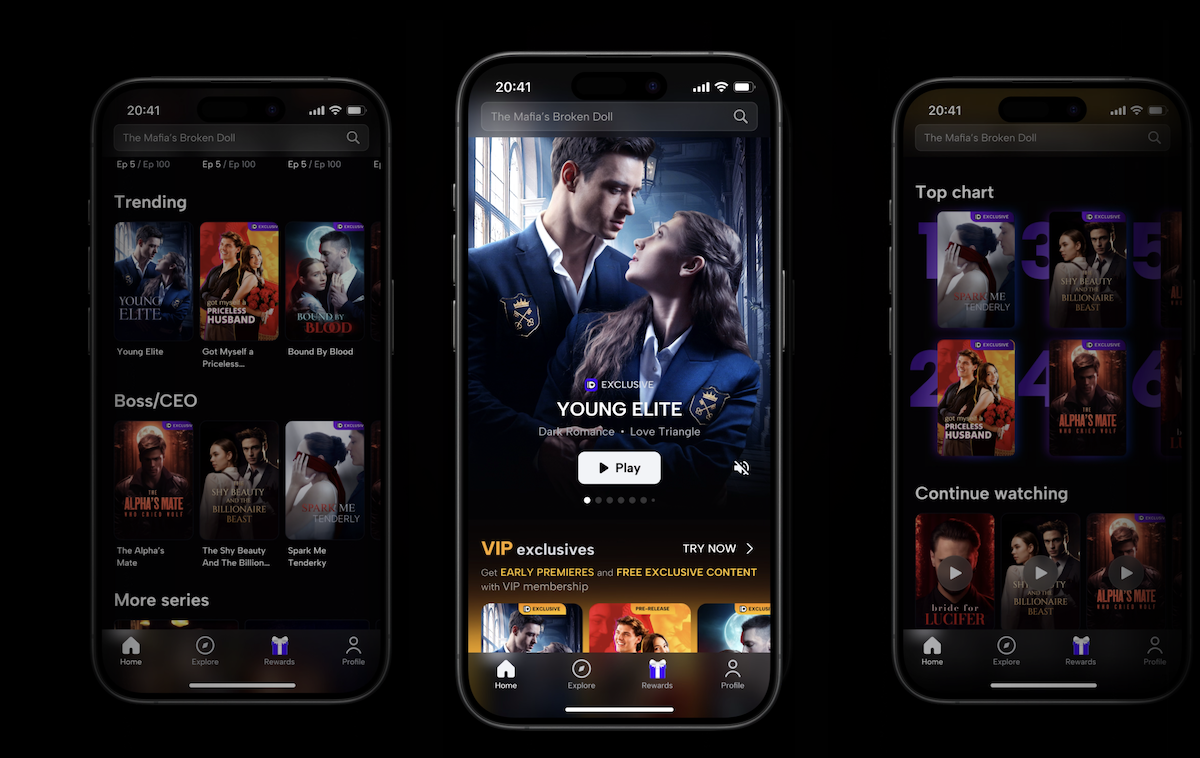
Laid end to end, the milestones show a few clear patterns. First, the overseas business still looks limited beside its origin: Omdia’s figures imply that most microdrama revenue in 2025 was earned inside China. Second, growth is likely slowing: after triple-digit growth across 2025, Sensor Tower puts the first quarter of 2026 at about $750 million, up 20 percent year on year. The contest at the top has grown tighter as well, with DramaBox and ReelShort each earning about $140 million in that quarter. Prices vary by country, platform and promotion, but monetization has taken on a familiar shape, with a weekly VIP pass costing about $19.99 in the US App Store as of September 2026 for apps such as ReelShort, ShortMax, DramaWave, GoodShort and My Drama. Production is the area most likely to change next, because DramaWave, whose annualized revenue exceeded $700 million by the second quarter of 2026, reportedly generates more than 80 percent of its new releases with AI. The product remains the one duanju producers built at home, a story sold a minute at a time, whether dubbed imports, Western originals or AI output win the next phase.